[ad_1]
Chopped liver, the Jewish version of chicken liver pâté, may not be as refined as the pâté, but it’s wonderfully flavorful and just as easy to make in your food processor.
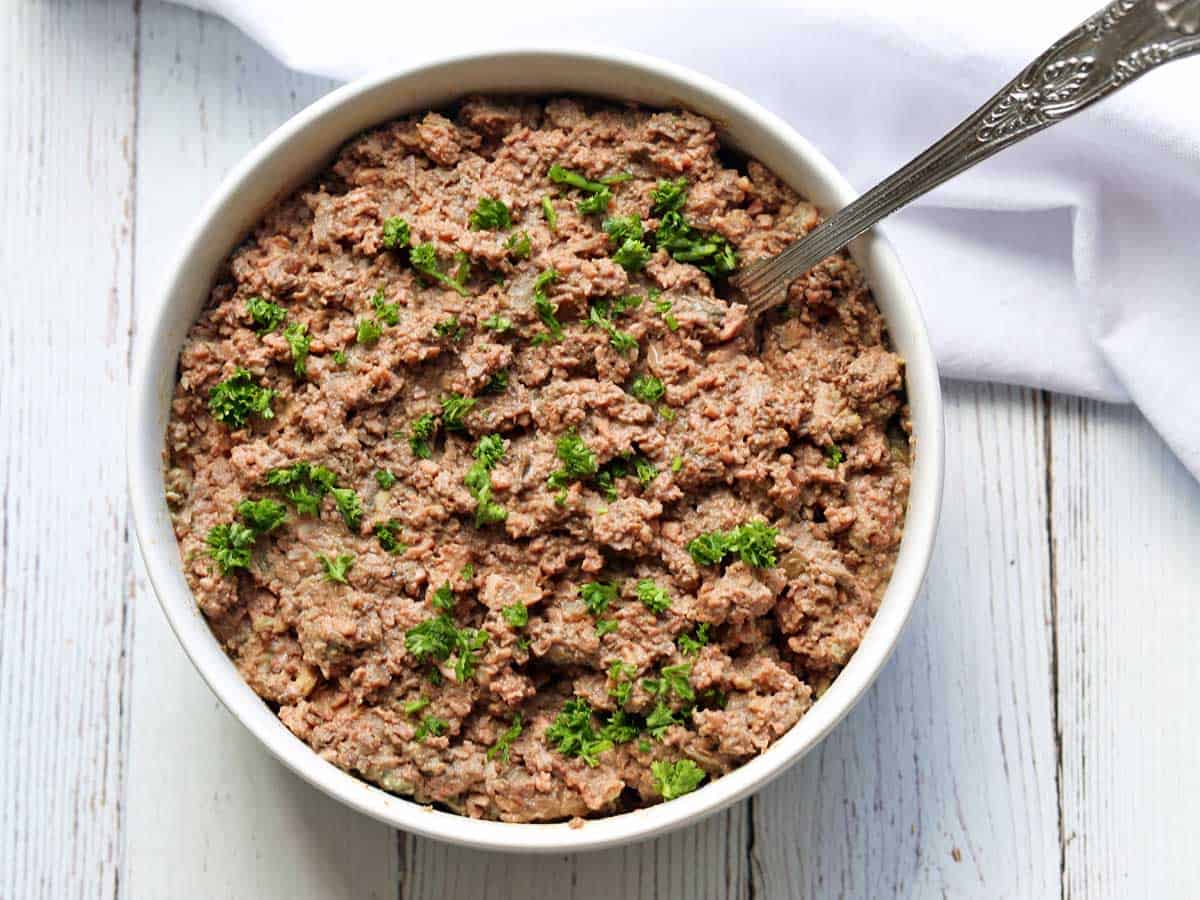
I might be in the minority here, but I love chicken livers. I like sauteed chicken livers topped with caramelized onions. And I also like them chopped or made into a pâté.
Chopped liver is, I suppose, the Jewish version of chicken liver pâté. It’s simpler, heartier, less refined, and just as important (for observant Jewish people), it’s kosher because it doesn’t contain butter or cream. I like both! I do appreciate the delicate texture and flavor of pâté. But I also love the more pronounced, bolder flavor of the Jewish version.
Jump to:
Ingredients
You’ll only need a few simple ingredients to make this hearty appetizer. The exact measurements are included in the recipe card below. Here’s an overview of what you’ll need:
Fresh chicken livers: I get them at the meat counter at Whole Foods. I believe they are widely available in U.S. supermarkets as well.
Hard-boiled eggs: These need to be hard-boiled, not medium-boiled. So if you follow this recipe for how to make hard-boiled eggs, leave them in the hot water for 12 minutes.
Extra-virgin olive oil: Traditional chopped liver is made with chicken fat. This ensures that the dish keeps Kashrut laws and does not mix meat and dairy. I prefer to use extra-virgin olive oil. It’s not only a wonderful choice. It’s also very tasty!
Onion: Chop it finely. This is a very important ingredient – it’s responsible for the dish’s bold flavor. It’s used here in much larger quantities than those used in a typical pâté.
Minced garlic: It’s best to use fresh minced garlic, though sometimes I use garlic powder instead. Garlic is not usually included in traditional recipes, but I like the flavor it adds.
Kosher salt and black pepper: If using fine salt, you should reduce the amount you use, or the dish could end up too salty.
Instructions
How to make chopped liver? It’s so easy! Scroll down to the recipe card for the detailed instructions. Here are the basic steps:
Cook the onions and garlic in olive oil. Transfer them to your food processor along with the hard-boiled eggs.
Add more olive oil to the skillet and fry the livers. Don’t overcook them!
Transfer the skillet’s contents, including the oil, to the food processor.
Add the salt and pepper and process just until smooth.
Refrigerate for at least two hours before serving.
Variations and substitutions
My recipe already departs from tradition by using olive oil instead of chicken fat (schmaltz in Yiddish) and adding garlic. If you’d like to vary it even more, you can experiment with adding more spices to the dish – try just a pinch of them. Good options include smoked paprika and cumin.
Serving suggestions
Chopped liver is wonderful on toast or on Matzoh for Passover. For the low-carb crowd, it’s really good on a toasted low-carb English muffin, thick slices of almond flour bread, or almond flour crackers. I often serve it with crudites and use the fresh-cut vegetables to scoop it out.
This dish is traditionally served as an appetizer on Jewish holidays. My grandma used to make it for Rosh HaShanah and for Passover. But I just make it whenever I’m in the mood, and I often serve it as our main course, alongside some quick pickles, stuffed olives, and crudites.
Storing leftovers
Chopped liver tastes best after it had a chance to rest in the fridge, covered, for a few hours, allowing the flavors to meld. But it doesn’t keep long in the fridge.
Plan to make it the day you serve it, a few hours ahead, and then finish it within a day or two. Store it in the fridge in an airtight container.
You can also freeze it, although it will lose some of its creaminess. After defrosting, try mixing in a little more olive oil, and mix it well so that it becomes fluffier.
Frequently asked questions
It has a rich, deep flavor and smooth texture. It’s very similar to pâté. It gets a lot of its flavor from caramelized onions and from the fact that it’s high in fat – and fat tastes good.
They’re similar, but chopped liver is made with lots more onions, hard-boiled eggs, and chicken fat; while pâté is made with a small amounts of onions or shallots, butter, cream, and often a bit of alcohol such as brandy. Pâté is certainly more refined, both in terms of flavor and in terms of texture. But both are delicious!
They’re actually very different. Chicken liver is considerably milder in its flavor than beef liver, which is very strong-flavored (even calf’s liver which is milder). Chicken liver also has a softer texture. If one would like to try livers for the first time and is hesitant, chicken is probably the way to go.
Subscribe
I typically publish a new recipe once a week. Want the new recipes in your inbox? Subscribe!
Recipe card
Chopped Liver: A Surprising Delicacy!
This unique chopped liver recipe is made with extra-virgin olive oil instead of the traditional chicken fat. It’s not as refined as chicken liver pate, but it’s wonderfully flavorful.
Servings: 8 servings
Calories: 169kcal
INSTRUCTIONS
-
Place the chicken livers on paper towels to drain. Place the eggs in your food processor bowl.
-
Heat 2 tablespoons of the olive oil over medium-high heat in a large 12-inch skillet. Add the chopped onion and fry until golden, stirring occasionally, about 5 minutes.
-
Add the garlic and cook a few more seconds, just until no longer raw. Using a spatula, transfer the skillet contents, including any remaining oil, to the food processor.
-
Add 2 more tablespoons of oil to the skillet. Add the chicken livers and cook them over medium heat (not higher or they could burst) until brown on the outside and barely pink on the inside, about 3 minutes per side. Overcooked livers are dry and grainy.*
-
Again, use the spatula to transfer the skillet contents, including the livers, the oil, and any tasty bits left on the bottom of the skillet, to the food processor.
-
Add the salt and pepper. Process briefly, about 30 seconds, stopping once to scrape the sides and bottom with a spatula. You don’t want the chopped liver to be as smooth as a liver pate. It should have a bit more texture to it.
-
Transfer the chopped liver to a serving dish. Cover and keep in the fridge for at least two hours, allowing the flavors to meld. Don’t eat it when still warm! It won’t be very good. It needs time to develop its deep flavor. Its flavor, as well as its texture, greatly improves after a rest in the fridge.
NOTES
Serving: 3oz | Calories: 169kcal | Carbohydrates: 4g | Protein: 12g | Fat: 11g | Saturated Fat: 2g | Sodium: 204mg | Sugar: 1g


More recipes to try
[ad_2]
Source link